All posts by John

Emilee Parnell

Emilee is from Southampton and lived in Winchester whilst at University.  She attended Foundation at the University of East London. When not in the studio, she splits her time between the gym, watching movies and being with her family.

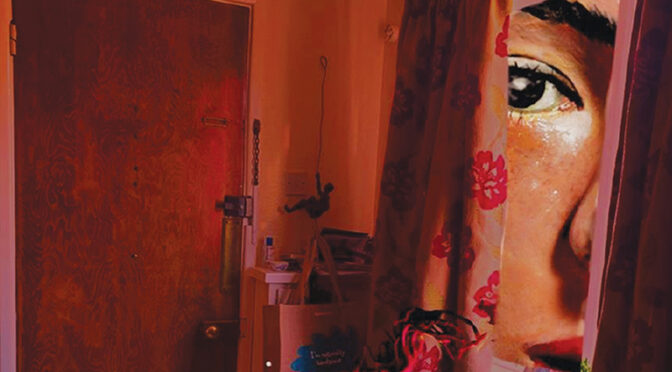
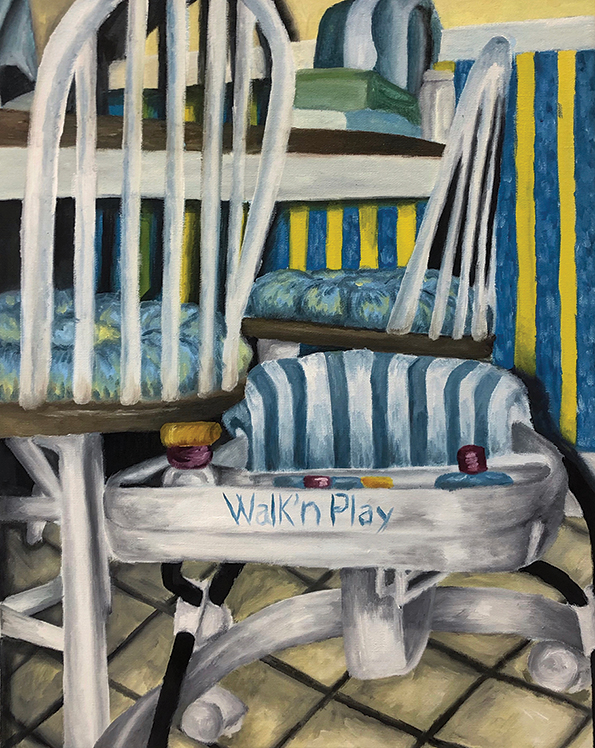
She is a painter, working predominantly with oils, but also has a great love for pencil drawing. Her work is inspired by family photographs and the world within the domestic home.

My fascination with memory and nostalgia has been the driving force behind my current project. I’ve used photographs from my own family’s collection as inspiration for my work and recreated them in oil paintings. The paintings are a response to these photographs. I use a combination of the photograph as reference and my memory to recreate them. The varying levels of detail in select sections of each painting is a reflection on whether they hold more or less value to me in correspondence to whether they are more vivid in my memory. I’ve also gone further and chosen to remove the human figure from these paintings to emphasise the loss of my younger self, as the child in the photographs is grown up now. But also in creating these paintings as an adult, I’m metaphorically trying to place myself back into these once familiar domestic scenes which I was once surrounded by every day.
Caroline Perkins

Caroline is from Cornwall where she moved to do a ceramics degree in her 30s. She now lives in Andover.

She takes part in Bad Poets, Shared Calm, and the External Events Committee. 

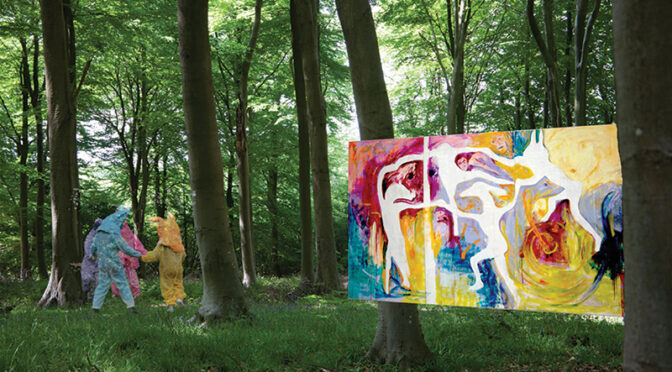
She has collaborated with many of her student cohort, making an installation with Alex, and creating costumes for Harry, Emilee, Bianca, Thea, Trish and Oliver, to wear in a performance in the painting Salon.  Caroline then took those students outside to a woodland environment where she choreographed and filmed the performance. As an artist, she addresses the connectedness of things, mythology, fairy tales, gods and goddesses, animal characteristics in ourselves and the human characteristics we see in animals; she links all these to cultural references and the everydayness of life.

My work is about Duality and Simultaneity; how we can be, at once, one thing and another. The ability to hold contradictory ideas is fertile ground for creativity, but it is impossible to carry continuous contamination of those dualities. I want to surprise myself.  I take inspiration from the past, and from spiritual mythologies that are still present and carry symbolic meaning today. I respond to the ideas presented by particle physics, quantum theory of entanglement, intra-action and interconnectedness: how we are symbiotic to the environment we live in and how we destroy at the same time. How then does this relate to my practice? I am hoping that by exploring other artist work who address these themes I can see how they have incorporated this into their work. In relation to my own work, I have only the beginning of an answer.

Symposium session:

Madeleine Phillips

Madeleine is from Salisbury and attended Foundation at Bournemouth and Poole College.

She was in the New Media studio for Year 2 and Sculpture in Year 3, working across media with an emphasis on drawing, with some textiles in narrative, psychological explorations, playful and dark.

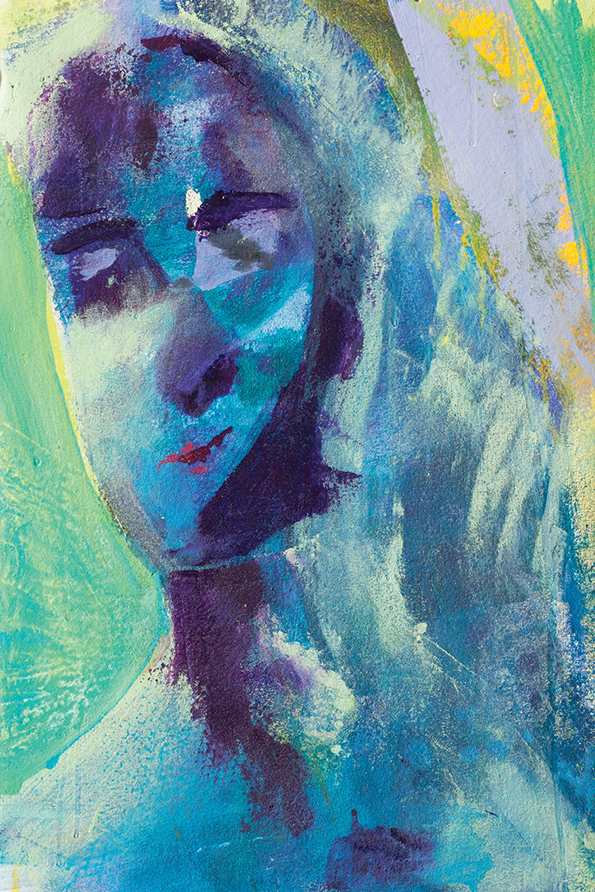
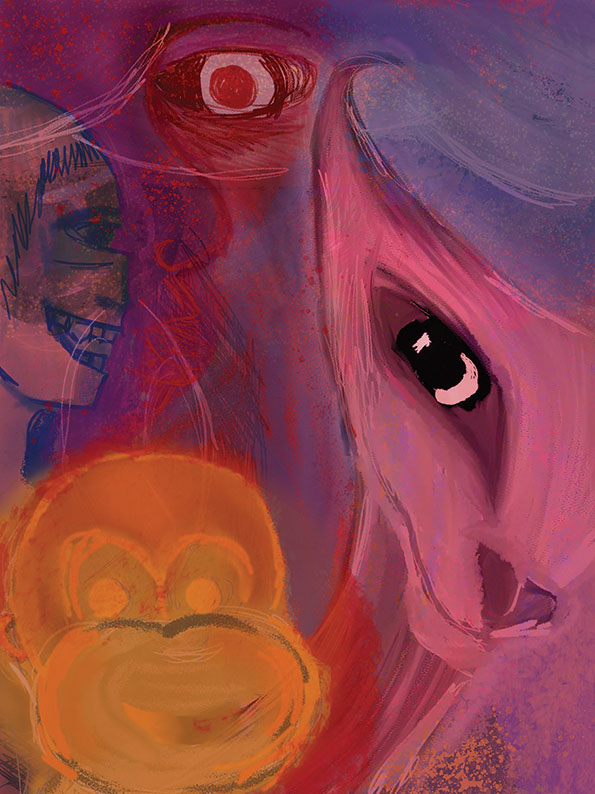
I use drawing, painting (both traditional and digital), sculpture, video, textiles and collage. As well as doing this, I combine these mediums in an experimental way. My main ideas stem from drawing as it is a way of expressing my ideas in a raw form; this process enables me to self-reflect on experiences and emotional states such as anxiety, dissociation, isolation.  I am drawn to the use of figures as my main method of articulating myself. I also use symbolism, self-portraiture, atmosphere and textures to explore these themes.

Tamar Phillips

Tamar is from Frodsham, near Chester in Cheshire. She attended Priestley College in Warrington. She works at the Holiday Inn as a room attendant.

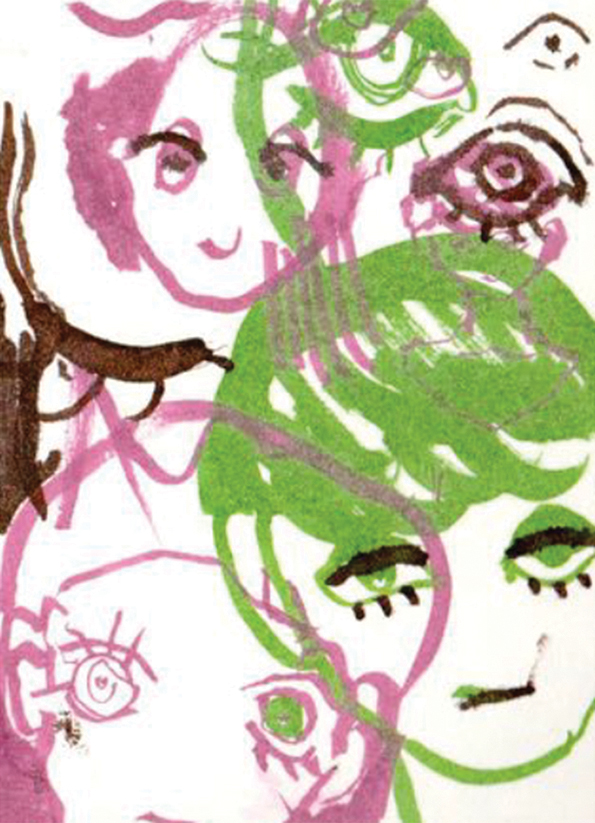
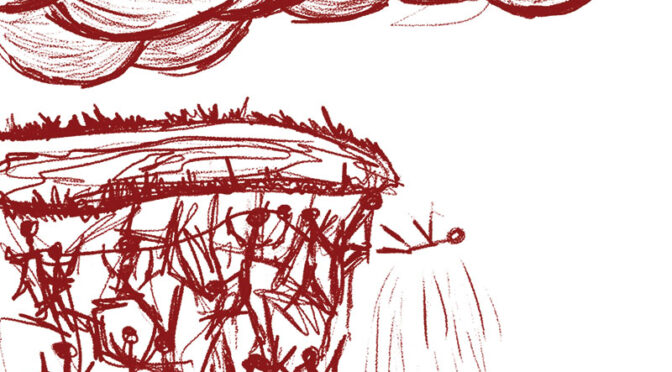
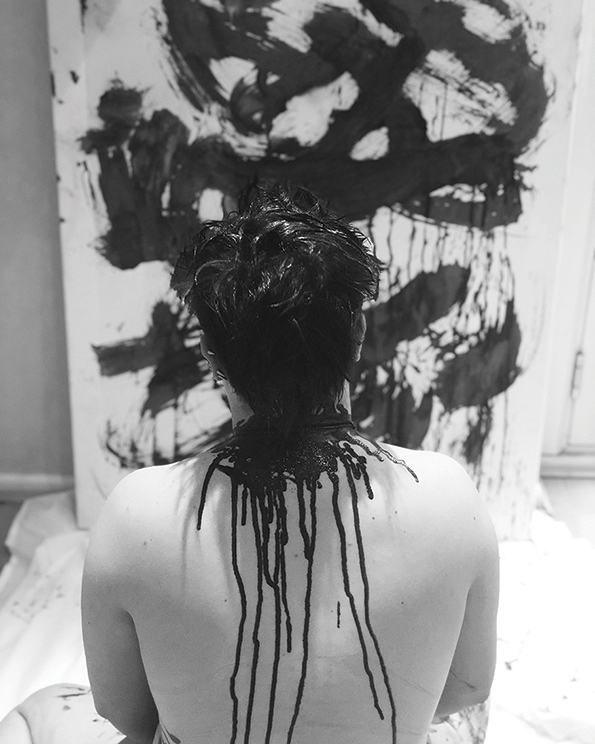
My practice is a representation of self, to access a greater understanding of the subconscious mind, exploring visual material produced automatically. Although my practice is an exploration of myself, the viewer can see themselves in the work as well as me.

I find putting pen to paper the most direct approach when trying to gain access to the subconscious mind: it is a free flowing and uninterrupted medium allowing less time for the mind to consider what imagery might appear. But the work has followed a natural progression into digital painting with the restrictions our current way of living has put on my practice, and by creating both digitally and by applying pen to paper I have added another layer to the fantasy.

Nathan Pine

Nathan was born in London and brought up in Hastings. He is a youtuber where he expresses his interest in makeup, making music and other varying subjects. Is currently an aspiring tutor specialising in the subjects of Art and Photography, amongst pursuing other career prospects in the creative industries. 

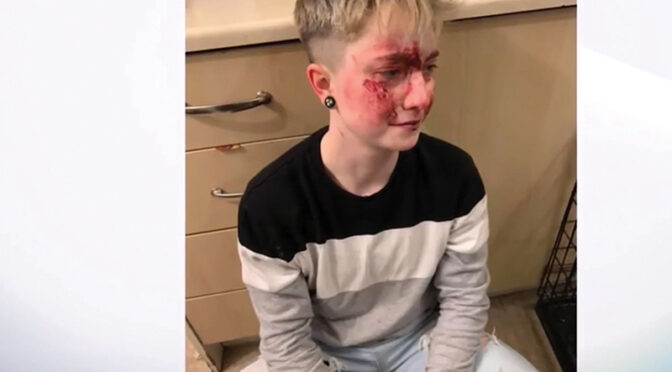
I mainly make films, using my own footage and some from interviews, performances and other short art films. The aim of my practice is to question the relevance of masculinity within our society and challenge masculine supremacy and the destruction it causes for the LGBTQ+ community. I am confronting the heteronormative bias we currently have in our society. Masculinity is toxic; the stigma of what is stereotypically associated with masculinity and femininity to enhance a male superiority complex is extremely destructive. As a LGBTQ+ man living in this heteronormative society, I use my knowledge and present frustration and channel it into my art. 

Emily Jayne Ponting

Emily is from the Cotswolds. She completed a BTEC in Art and Design at Cirencester College.

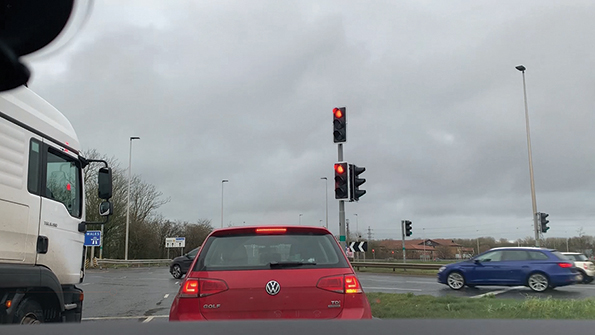
She is a Student Ambassador, passionate swimmer, goes to the gym, and works at Tesco, driving home at weekends for the purpose. She likes the drive, and footage taken on the journey has fuelled her practice during lockdown.

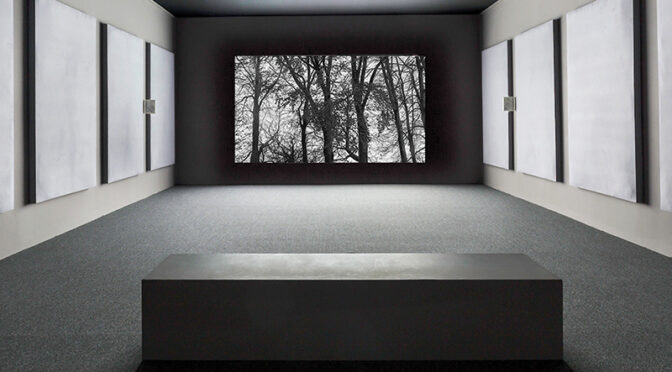
My work is focused around mental health and the impact it has on myself and our society. I am currently using art as a source that helps support my emotional stability, along with experimenting to affectively present work that increases mental health awareness. I engage with different forms of technology to communicate the positive impression that art has on the human brain when struggling mentally. This emotional release is formed through the process of making and upon viewing contemporary art; of which I feel is important in order to reduce any built-up, negative energy that could potentially lead to further psychological issues. I explore the still and moving image to develop a story behind my work, along with the use of techniques such as manipulating imagery and appropriation. I understand through my own emotional connections, that it is not easy to face sensitive subjects and it is simpler to avoid them. I am using my practice to face this issue head on. In order to allow my work to make a difference and decrease the silence that mental health carries; I have realised that I need to lead by example, open up, connect with my audience on a more personal level and share my own emotions.

Symposium session:

Jhon Dave Rafferty

JD is from London and lives in Southampton He did A levels at the London Oratory. He has a part-time summer job as a kosher pastry chef in Willesden Green. He writes songs and perform in bars, in the first year through the Live Music Society.

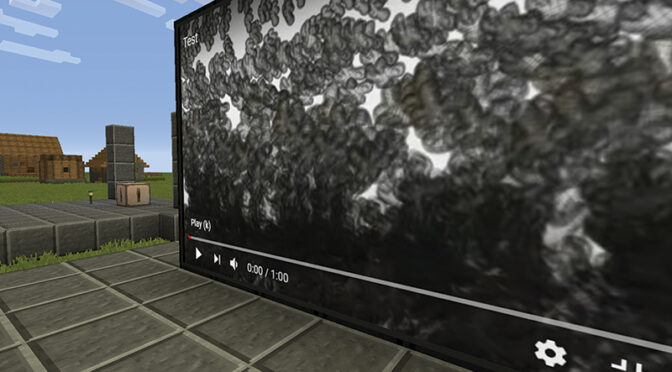
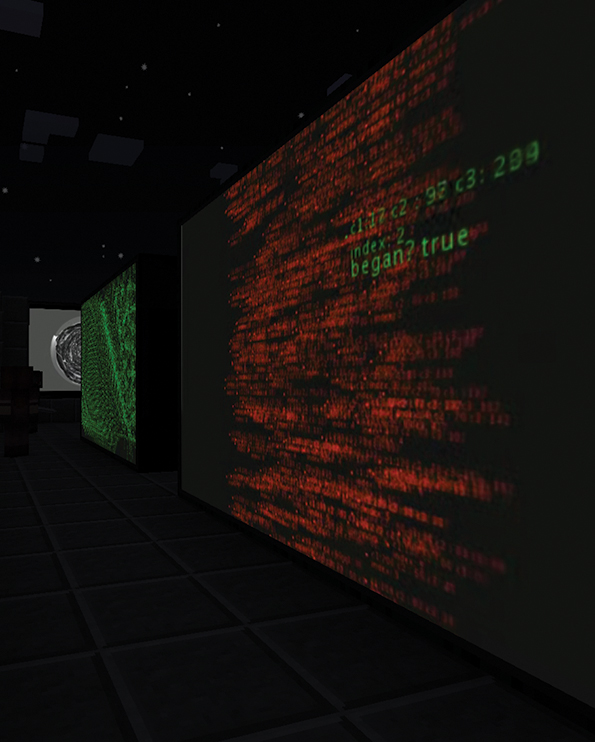
His studio work is computer-based, using the coding he learned in after-school sessions in sixth form. He is interested in the transformation of scientific images – metamorphosis or evolution – on the border between art and maths, to provide a hypnotic experience that affects the way you see afterwards.  He starts with a drawing for its ease of control, scans and enhances it.

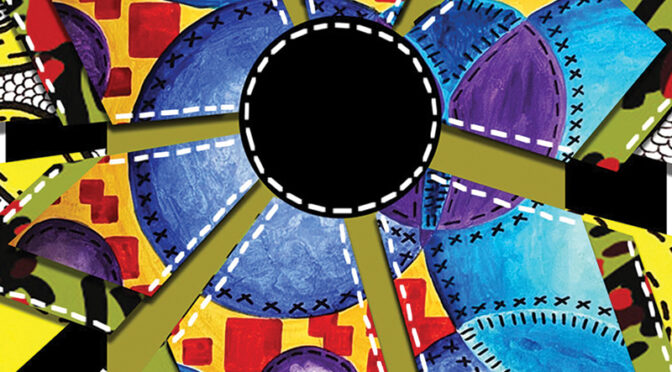
My art practice attempts to explore the dynamic borders between the hand-crafted art and its digital production. My experience in digital art creation has led to conflicting faculties of art making, a conflict that can at surface level be observed in a wider context of digital technologies impact on contemporary issues. 

The art itself takes the form of animation/videos of a generative system containing variations of shape and forms based on hand drawn images. These drawings are processed and compiled through the programming language ‘processing’ and java and photoshop to create the system. The use of code in art became an important part of the practice as the process was able to actively live out the frequent conflicts and occasional harmonies when the digital meets the non-digital form. Images that are drawn are usually based off the diagrams of biology textbooks like bacteria and insects.

Pratigya Rai

Rai has been based in the Sculpture studio, working with a broad range of media. 

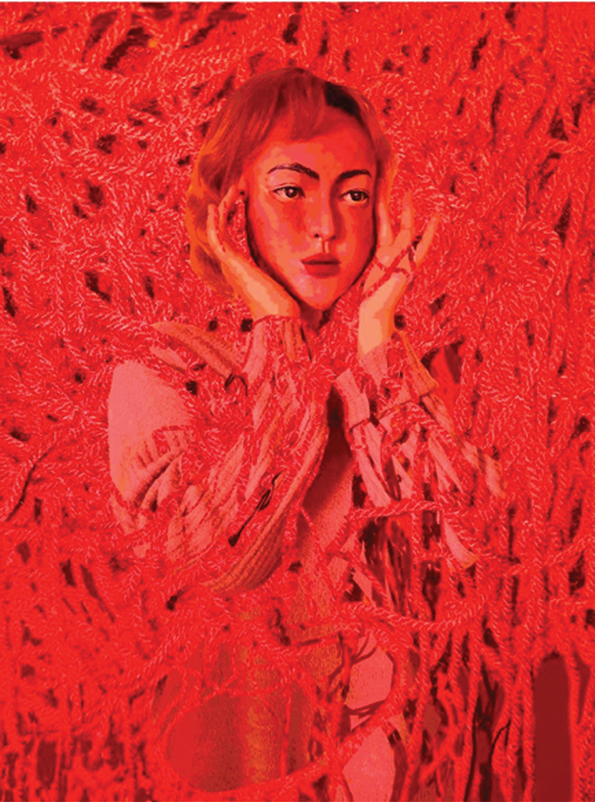
My current art practice is heavily based on improvisation and I typically do not create a strict plan or blueprint but rather have a vague image or idea in mind. My process of creating work is performative and driven by my relationship with the selected materials which are rich in symbolism, cultural significance and have anthropological ties. There are a few commonalties within my work such as my fascination with the colour red and lines that appear in many forms. I create ambiguous work that purposely avoid falling into specific set categories or being coloured with a definitive agenda.

Lucy Rayson

Lucy is from Birmingham, and attended Foundation at Warwickshire College Group, Royal Leamington Spa, where she found her love of feminist artwork.  She is a member of the LGBTQ+ Society, works at Tesco, and is part of a clay-pigeon shooting club in Birmingham, where she’s been a member since the age of 11, a hobby she shares with her dad.

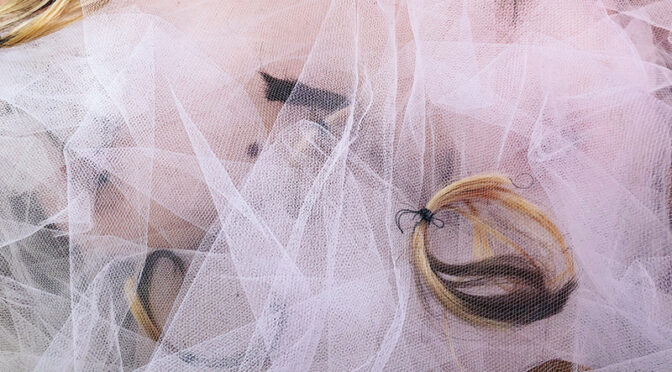
My practice explores the taboo of hair within society and how women face different challenges with exercising their own control and choice over their own body hair. I have explored different cultures’ and religions’ views on hair as well as body hair and have looked at how different women have broken the norms and have chosen to make their body hair a feature and the responses they receive for their choice. Within my practice, I have also looked at medical conditions regarding hair loss. I took inspiration from my own personal experiences as I have struggled with stress-related alopecia for a few years and I have used moments from my own life and incorporated it into my physical works. I have used a range of materials but mainly real human hair. I wanted the pieces to contain a jarring element and a nod to the uncanny, as the sight of hair detached from the body is not one many viewers find comfortable to look at. My practice questions why society has a strong say in how people choose to groom themselves.

Nadia Sarwar

Nadia is from Ruislip in west London; she did Foundation at West Herts College in Watford. She is a Student Ambassador and works at Tesco. Work experience with the Trinity Mirror Group in the Fashion and Editorial department, shadowing the editor, seeing what goes into creating and designing a magazine, provided a new starting-point for her practice.

My current practice exploits the use of digital software and printmaking, to address the highly pressurised world of the fashion industry and the ability it has to construct our identity, whilst maintaining historical and cultural elements from its production process. I explored the process of fashion publishing, digitally recreating magazines covers, to illustrate the fast-paced and methodological process of constructing and mass producing a magazine in our digital era. This reconstruction of the motion of working towards a final outcome, e.g. from the selection of imagery, to the final print, has allowed me to juxtapose the slow, small-scale preparation, which has then been mass produced into this large-scale fast fashion industrial output. In my recent works, I have shifted from solely focusing on the technical production process of constructing a magazine, to looking in-depth at the fashion industry as a whole, thinking about the process of pattern cutting and fabrics, to illustrate the global procedure from the factory production in third world countries, to the retail output.

Symposium session: